






You’re exercising, eating better, and you may already be noticing the first changes in how your clothes fit. Yet the number on the scale still seems stuck in the same place. Does that mean nothing is happening? Let’s find out.
Same weight, different body
A standard bathroom scale tells you how much you weigh. It doesn’t tell you how much of that weight comes from muscle, fat, or water.
That’s why the number itself can be a little misleading. If you exercise regularly, especially if you do strength training, you may gradually lose fat while gaining muscle mass at the same time. Your overall weight may not change much, even though your clothes fit more loosely and your body looks firmer.
Muscle is not actually heavier than fat, as people often say. A kilogram is still a kilogram. Muscle tissue is simply denser, so it takes up less space at the same weight.
Why your weight changes from day to day
The number you see on the scale in the morning is not fixed either. Body weight naturally fluctuates throughout the day, and a short-term change does not necessarily mean you have gained or lost body fat.
It can be affected by the amount of water in your body, a salty or carbohydrate-rich meal, digestion, physical activity, or hormonal changes. After a demanding workout, the scale may even show a higher number than the day before without saying anything meaningful about your actual progress.
That’s why it makes more sense to follow the trend over time rather than focus on individual readings.

What to track besides kilograms
If you want a better idea of how your body is changing, you can look beyond total body weight and focus on values such as body fat percentage, muscle mass, or body water.
This is where smart scales have an advantage over standard ones. Using bioelectrical impedance analysis, they estimate body composition and allow you to track several values at once.
It is worth keeping in mind, however, that a home smart scale does not replace professional measurement. Treat individual readings mainly as estimates and look at them in a long-term context. If you weigh yourself under similar conditions each time, it becomes easier to see the direction in which the different values are moving.
One measurement doesn’t tell you much. The trend does.
This is often where the biggest problem starts. You weigh yourself on Monday, then again a few days later, and suddenly every few hundred grams feels important.
A better approach is to keep the conditions similar each time you weigh yourself. For example, in the morning, after using the bathroom, and before breakfast. You do not necessarily have to step on the scale every day. What matters most is comparing measurements taken under similar conditions.
Tracking the trend will tell you far more than one random number.
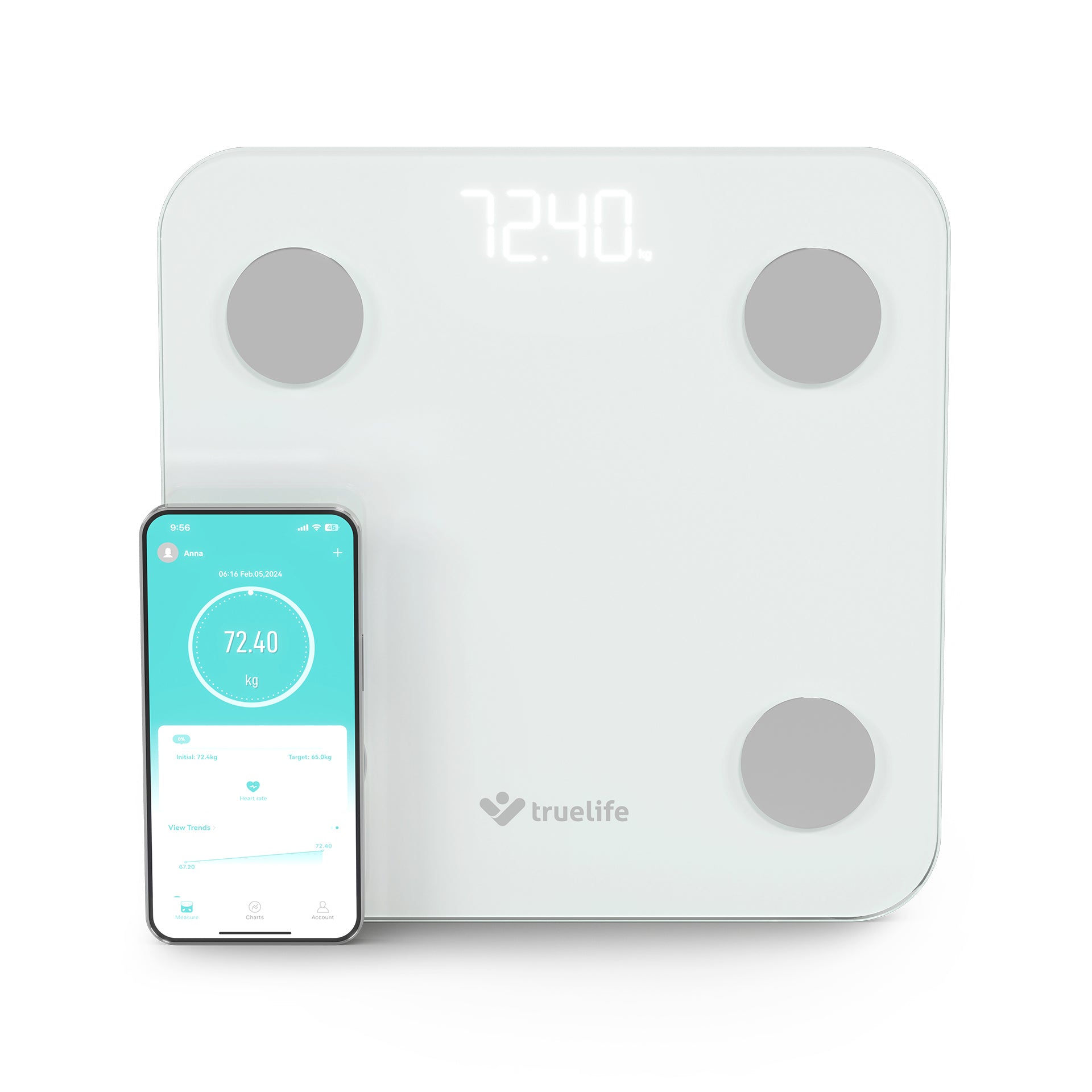
The Truelife FitScale W6 BT can help with that. In addition to body weight, it uses bioelectrical impedance analysis to track a total of 19 body metrics. These include body fat percentage, muscle mass, body water, and visceral fat.
Seven values are shown directly on the colour display, while the full overview is available in the mobile app. The app stores your measurement history and clear statistics, so instead of comparing today with yesterday, you can see how your body is changing over several weeks or months. The data can also be synced with Apple HealthKit or Google Fit.

Progress isn’t only visible on the scale
Numbers can be useful, but they are not the only way to tell whether you are moving in the right direction.
Pay attention to how your clothes fit, whether you can handle more resistance during workouts, run the same route more easily, or have more energy during the day. If you want to track changes in more detail, you can also measure your waist, hips, or thighs from time to time.
And don’t expect every metric to change at the same pace. The body does not work according to a spreadsheet, and short-term fluctuations are a normal part of the process.
Don’t let one number decide whether you’re making progress
A scale can be a useful tool if you know how to read the results. Instead of chasing the lowest possible number, focus on the bigger picture and, above all, on long-term progress.
You may then find that even if your weight barely changes for several weeks, your body is still moving in exactly the direction you want.